Embodied AI
How embodied agents learn through the closed loop of perception, action, and consequence, why data trustworthiness rather than data volume decides whether a policy transfers, and how pooled cross-embodiment corpora changed the field.
How AI systems join language, vision, audio, and physical sensor signals into one representation, why the shared time reference rather than the model is the real reliability surface, and how time-aligned corpora changed what these systems can be trained on.
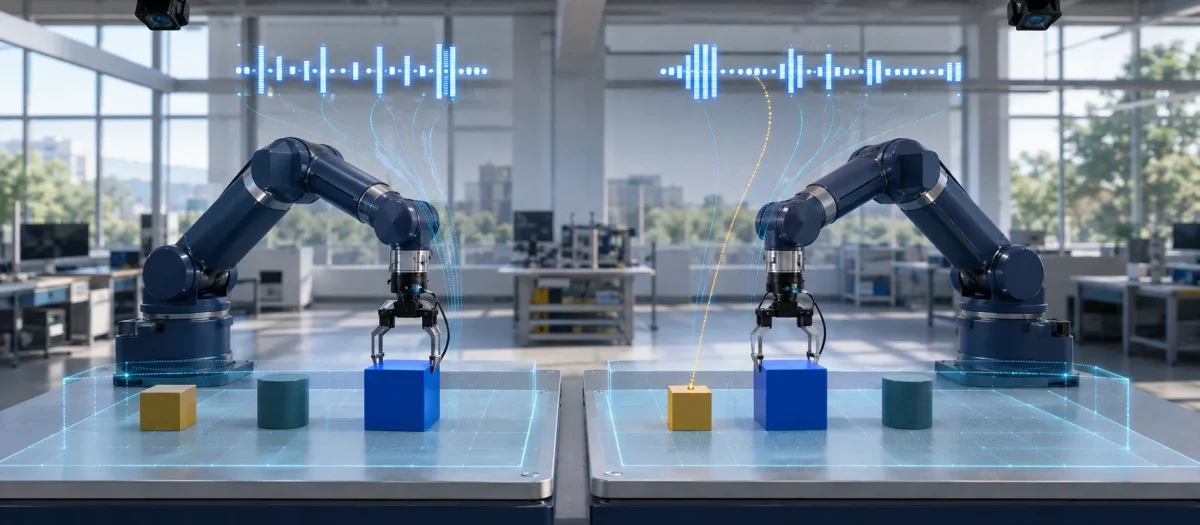
Multimodal AI builds systems that take in more than one kind of signal at once, such as images, language, audio, depth, force, and motion, and produce a single interpretation or a single action from them. It matters because the physical world does not arrive as one clean stream. A robot deciding whether it has actually grasped a cup needs vision and force together, and either signal alone gives a confident wrong answer. The central tension of the field is that the value lives in the relationship between signals rather than in any one of them, so the hard problem is not collecting more data but proving that every part of one sample describes the same moment. That makes most reliability work in multimodal AI alignment and evaluation work rather than model work.
Multimodal AI covers any system whose inputs, outputs, or internal representation span two or more modalities that carry genuinely different information. The standard academic decomposition comes from Baltrusaitis, Ahuja and Morency, whose 2017 survey Multimodal Machine Learning: A Survey and Taxonomy names five core challenges: representation, translation, alignment, fusion, and co-learning. Those five still describe the field accurately, and alignment is the one that industry consistently underestimates. [[Cross-modal Alignment]] treats that challenge on its own terms: what has to hold before two streams agree on which of their parts refer to the same thing, and the measured evidence that a robot policy can score well on an instruction it is actively contradicting.
In scope: shared embedding spaces that place image and text in one geometry, [[Sensor Fusion]] that combines LiDAR, radar and camera into one scene estimate, [[Vision-Language-Action Models]] that emit robot actions from pixels and an instruction, and generative models that produce video, audio and control signals together.
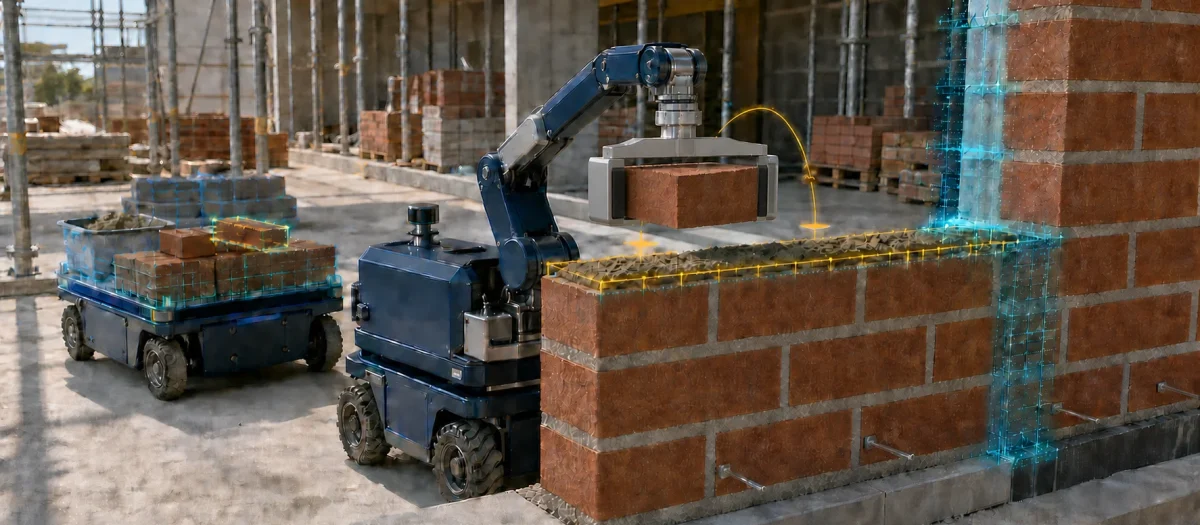
Multimodality becomes operationally important in [[Physical AI]], where a machine must connect language and perception with sensor state and physical action. It is equally foundational to [[Embodied AI]], where an agent learns through the closed loop between what it perceives, what it does, and how the environment changes. These fields overlap, but they are not interchangeable: multimodal AI describes how different signals are represented and combined, while physical and embodied AI describe intelligence acting through a body in an environment.
Explicitly out of scope: a system that merely accepts several file types and routes each to a separate single-modality model. If the modalities never meet inside a shared representation, the pipeline is a set of unimodal systems behind one interface. A language model also does not become multimodal because captions appeared somewhere in its training corpus. The test is whether the model’s output changes when one modality contradicts another.
The industry term and the academic term diverge in one useful way. Research usually says multimodal when it means learned joint representation. Robotics and autonomy teams often say multimodal when they mean multi-sensor capture, which is an upstream data property rather than a model property. Both usages appear in this graph, and the distinction matters because a multi-sensor dataset can be recorded correctly and still be useless for joint representation learning if its streams are not aligned in time.
| Period | Milestone | Significance |
|---|---|---|
| 2017 | Multimodal Machine Learning: A Survey and Taxonomy published | Establishes representation, translation, alignment, fusion and co-learning as the field’s problem set |
| February 2021 | OpenAI releases CLIP, trained on 400 million image and text pairs | Contrastive pretraining makes a shared image and text embedding space a reusable primitive |
| April 2022 | DeepMind publishes Flamingo | Interleaved image and text sequences enable few-shot visual reasoning without task-specific training |
| May 2023 | Meta releases ImageBind, binding six modalities | Shows a joint space can be learned without paired data for every modality combination |
| July 2023 | Google DeepMind publishes RT-2 | Treats robot actions as tokens a web-pretrained vision language model can emit, creating the VLA category |
| October 2023 | Open X-Embodiment pools 60 datasets from 34 labs | More than 1 million real trajectories across 22 embodiments and 527 skills, with RT-2-X showing roughly 3 times better generalization to unseen skills |
| November 2023 | Meta and 15 university partners release Ego-Exo4D | Simultaneous first-person and third-person capture, reaching about 1,286 video hours in v2 |
| October 2024 | Physical Intelligence releases pi-0 | A generalist policy trained across single-arm, dual-arm and mobile platforms, fine-tunable with 1 to 20 hours of task data |
| March 2025 | Google DeepMind announces Gemini Robotics and Gemini Robotics-ER | Splits embodied reasoning from motor control while keeping one multimodal backbone |
| April 2025 | Physical Intelligence publishes pi-0.5 | Co-training on heterogeneous sources produces manipulation in homes the model never saw |
| October 2025 | Gemini Robotics 1.5 technical report | Motion transfer moves skills between embodiments, and the model reasons in natural language before acting |
| May 2026 | NVIDIA launches Cosmos 3 | An open omnimodel over text, images, video, ambient sound and actions, with action prediction inside the same system as world generation |
The pattern the table reveals is a steady widening of what counts as a modality. Text and image were joined first, then audio and depth, then action itself. Action becoming a modality that models generate rather than a separate control stack is the shift that pulled multimodal AI into robotics.
Representation alignment became a reusable primitive. Before CLIP, joining two modalities often meant designing a fusion architecture for each task. After it, teams could start from a pretrained shared embedding space rather than learning that relationship from scratch. This lowered the model-design cost of adding scale and helped general multimodal backbones emerge, even though aligning the underlying data across modalities remained a separate operational problem.
One architecture now absorbs a wider range of modalities. Tokenization plus attention reduced the need for modality-specific encoders as a design commitment, though many production systems still retain lightweight per-modality front ends. Cosmos 3 is the current end point of that trend, described by NVIDIA as an omnimodel that natively understands and generates text, images, video, ambient sound and actions in one system.
Cross-embodiment pooling proved that transfer is real. Open X-Embodiment was the first large test of whether data from one robot helps another, and RT-1-X improved on robot-specific methods by roughly 50 percent on small datasets. That result changed data strategy across the field, because it made a shared corpus worth contributing to.
Synchronized capture hardware got cheap enough to deploy at scale. Ego-Exo4D captured 740 participants across 13 cities with time-aligned egocentric and exocentric rigs. Multi-sensor capture increasingly moved out of pure lab settings into something an operations team can run at scale.
Generation closed the loop back to control. World models that emit joint angles, gripper positions and trajectory points rather than only video mean synthetic data can be used for policy training and evaluation, not only for perception pretraining.
None of these solved alignment at the data layer. Every one of them assumes that when a sample arrives with a camera frame, a force reading and an instruction attached, those three things genuinely belong to the same instant. Nothing in the model stack verifies that assumption, and nothing in it recovers when the assumption is false.
| Dimension | Single-modality AI | Multimodal AI |
|---|---|---|
| Unit of data | One record, self-describing | A bundle of streams that must be asserted to describe one event |
| Time reference | Usually irrelevant, order is enough | A shared clock is part of the label, not metadata |
| Dominant failure | Wrong prediction on a correct input | Correct prediction on a silently misassembled input |
| Ground truth cost | One annotation pass | One pass per modality plus a cross-modal consistency pass |
| Missing input | Absent record, easy to detect | A stream that is present but stale, which looks valid |
| Evaluation | Held-out accuracy on the same distribution | Requires deliberate contradiction and dropout tests |
| Recovery from bad data | Relabel the affected records | Re-derive alignment for the whole capture session |
The time reference row causes the others. Once correctness depends on a shared clock, the unit of data becomes a bundle rather than a record, missing inputs become indistinguishable from stale ones, evaluation has to probe disagreement rather than accuracy, and a repair reaches back through an entire session instead of a set of rows. Teams that treat timestamps as metadata inherit all six of the other rows as surprises.
The practical challenge is that multimodal data can be wrong in a way that passes every check a unimodal pipeline knows how to run. Each stream is well formed, the file counts match, the annotations are complete, and the dataset is still corrupt because the streams describe different moments.
Take one concrete task: a mobile manipulator in a warehouse picking a deformable item, a shrink-wrapped pack of paper towels, out of a mixed tote. To learn this from demonstration the system needs an RGB frame at the moment of contact, a depth estimate of the tote’s contents, force and torque readings through the closing motion, joint states for the arm, the language instruction that scoped the task, and a success signal recorded after the item cleared the tote. Six streams, at different native rates. The camera runs at 30 Hz, so a frame arrives every 33 milliseconds. The force torque channel runs near 1 kHz. The label that matters, the instant of first contact, is a relationship between two of those streams and exists in neither one alone.
Now let one clock drift. If the force channel’s timestamps slip by 120 milliseconds across an eight hour collection shift, first contact gets attributed to a frame roughly four camera frames before the gripper actually touched anything. Every affected sample teaches the policy to begin closing early. Nothing in the dataset looks wrong: the images are sharp, the forces are plausible, the annotations are complete, and validation accuracy is fine because the validation set drifted identically. The failure surfaces in production as crushed packs, and by then the training corpus has thousands of samples carrying the same bias, with no field recording which of them are affected. A correct label on the wrong moment is still incorrect data, and it is the most expensive kind because it is invisible to every quality check that inspects one modality at a time.
That is the failure mode worth designing around, and it is a data operations failure rather than a modeling one. No amount of architecture search recovers a corpus whose time reference was never established.
Leading organizations disagree materially about architecture. Physical Intelligence trains a single end-to-end policy and argues that co-training on heterogeneous sources is what produces open-world generalization. Google DeepMind splits the problem, putting embodied reasoning in one model and motor control in another, and reports skills transferring between an ALOHA2 platform, a Franka arm and Apptronik’s Apollo humanoid. NVIDIA bets that a generative world model can supply much of the training and evaluation data, positioning Cosmos 3 as a way to compress physical AI cycles from months to days. Meta invests in human capture rather than robot capture, on the view that egocentric human video is the scalable source. These are not compatible strategies.
They converge on three things anyway. All four publish or consume corpora where a sample is a bundle of time-aligned streams rather than a file. All four treat action as a modality inside the model rather than as a downstream controller. And all four have made cross-embodiment transfer, moving data or skills between robot bodies, an explicit design goal rather than an afterthought.
The inference that convergence supports is that the durable asset in this field is the sample contract, not the model. Model families and architectures have changed rapidly since 2021, while many of the same underlying corpora have remained useful across successive generations. Whichever architecture wins consumes samples whose modalities are aligned to a stated reference and whose gaps are declared. A team that gets the contract right can retrain on a new architecture in weeks. A team that got it wrong recollects.
Kotwel is the data-quality and data-operations partner for Physical AI. We turn multimodal physical-world and synthetic data into synchronized, structured, validated, and traceable datasets for training, evaluation, and continuous improvement. We make consequential data choices explicit and develop measurable quality criteria that enable organizations to benchmark and improve the data behind physical AI systems.
Kotwel works at the data layer and remains independent of hardware, sensing architecture, and model family. We define data-quality criteria, audit datasets, and assess conformance against documented requirements. Clients retain control over program-specific conventions, intended model behavior, and operating requirements, provided those choices are explicitly documented and consistently applied. We do not build robots or autonomy stacks, develop control systems, or train foundation models. Decisions about system safety, legal compliance, and deployment remain with the client and its qualified advisers.
For multimodal programs, Kotwel’s role begins with making the sample contract explicit once the program has set it: the reference clock shared by all streams, the alignment tolerance for each modality, and the states used to record missing or unusable inputs. These decisions turn a collection of camera frames, sensor readings, instructions, and actions into traceable samples that can be validated consistently.
The operational pipeline then enforces that contract. Ingestion normalizes streams against the declared time reference and checks timestamp consistency. Annotation records events against that reference rather than against the index of one stream. Cross-modal review checks whether the selected instant is consistent across the relevant modalities, while release validation identifies drift, undeclared gaps, and other session-level failures before the data enters training.
Kotwel’s scope ends with a verified dataset and its supporting provenance, schema, and quality records. Kotwel does not evaluate the client’s policy or promise a model outcome. Its contribution is to make the multimodal evidence entering that model synchronized, traceable, and auditable.
[[Sensor Fusion]] combines readings from several sensors into one estimate of the world’s state, usually with an explicit uncertainty model.
[[Cross-modal Alignment]] establishes which parts of two streams refer to the same event.
[[Multimodal Dataset Synchronization]] is the operational practice of putting every stream on a shared reference clock and proving the offsets stay inside tolerance.
[[Multimodal Learning]] covers the training methods that build a joint representation rather than routing modalities to separate models.
[[Contrastive Pretraining]] learns a shared embedding by pulling matched pairs together and pushing mismatched pairs apart, the method behind CLIP.
[[Vision-Language-Action Models]] emit robot actions directly from visual input and a language instruction, treating action as an output modality.
[[World Models for Robotics]] learn to predict how a scene evolves, and increasingly emit control outputs alongside generated video.
[[Egocentric Data]] captures the world from a person’s own viewpoint and provides a scalable source for robot learning.
[[Robot Demonstration Data]] records a human driving a robot directly, producing the aligned observation and action pairs that imitation learning needs.
[[Tactile Sensing]] supplies contact information that vision cannot recover, and is the modality most often omitted and later missed.
[[Synthetic Data for Robotics]] generated from world models supplies coverage for rare events, at the cost of a domain gap that has to be measured rather than assumed.
[[Multimodal Evaluation]] tests behavior under contradiction and dropout, including graceful degradation when a stream drops out entirely, because held-out accuracy on an identically assembled test set cannot detect assembly errors.
[[Building Reliable Multimodal AI Training Datasets]] covers the sample-level construction practices this hub summarizes.
Primary sources
Multimodal Machine Learning: A Survey and Taxonomy, Baltrusaitis, Ahuja and Morency, 2017.
Open X-Embodiment: Robotic Learning Datasets and RT-X Models, Open X-Embodiment Collaboration, 2023.
Ego-Exo4D: Understanding Skilled Human Activity from First- and Third-Person Perspectives, Grauman et al., 2023.
pi-0.5: a Vision-Language-Action Model with Open-World Generalization, Physical Intelligence, 2025.
Gemini Robotics 1.5, Google DeepMind, 2025.
Industry and strategy
Cosmos 3 launch announcement, NVIDIA, May 2026.
Gemini Robotics brings AI into the physical world, Google DeepMind, March 2025.
Multimodal AI’s value comes from the relationship between signals, so a sample is a bundle of time-aligned streams rather than a set of files.
The dominant failure is a correct label attached to the wrong moment, which passes every quality check that inspects one modality at a time.
Model families have changed rapidly since CLIP appeared in 2021, while well-constructed corpora can remain useful across multiple generations. This makes the sample contract a more durable asset than any single architecture.
Leading labs disagree about architecture and about real versus synthetic data, yet all of them converge on time-aligned bundles, action as a modality, and cross-embodiment transfer.
Kotwel’s contribution is to make the program’s sample contract explicit and to enforce it: a declared reference clock, per-modality tolerance windows, declared missingness states, and a release test that rejects a drifted session as a whole.
Add sensors later only if the later capture can be aligned to the earlier one, which usually it cannot. Modalities recorded in separate sessions describe different events, so a force channel added six months after a video corpus produces two datasets rather than a richer one. If a modality is likely to matter, record it from the first session even at low quality, because a weak aligned signal is recoverable and a strong unaligned one is not.
No universal figure exists, because the added work scales with the number of modalities, their native rates, the required tolerance, and the available tooling, none of which stay constant across programs. Alignment adds work beyond per-modality annotation because someone or an automated validation layer must also check whether the streams describe the same event. A practical workflow may use automated timestamp checks followed by sampled cross-modal review. That cost should be compared with discovering drift after training, when an affected collection session may need to be reconstructed or discarded.
Yes, if the modalities meet in a shared representation and the output changes when they disagree. The test is behavioral rather than architectural. Feed the model an image that contradicts the text and see whether the answer moves. If it does not, the visual pathway is decorative.
Not yet for contact-rich behavior, where the domain gap concentrates in exactly the forces and deformations that are hardest to simulate. Synthetic data is currently strongest for coverage of rare events and for pretraining perception, and the gap has to be measured against a real held-out set rather than assumed to be small.
Treating timestamps as metadata rather than as label content. Teams stamp each stream with whatever clock its capture device provides, never reconcile them, and discover the offsets months later when a policy behaves oddly. Settling the reference clock is a harder prerequisite than annotation quality and should be closed before any labeling begins.