Summary
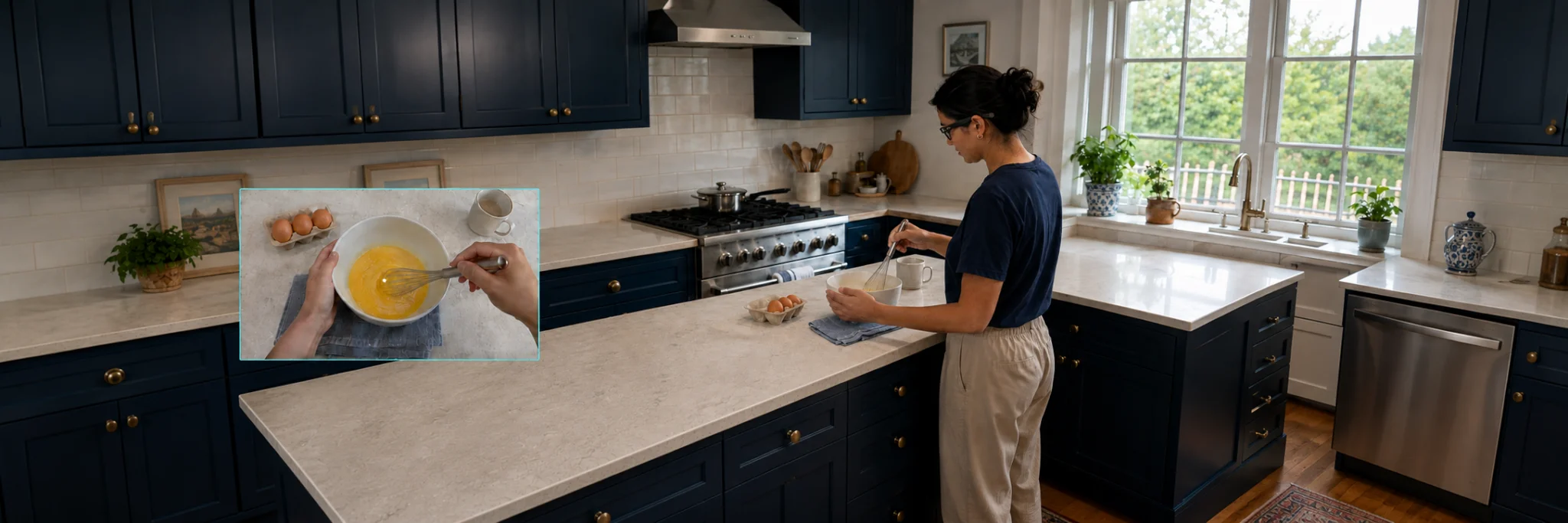
Egocentric data is sensor data recorded from the viewpoint of whoever is doing the task, on a camera worn on a person’s head or mounted on a robot’s own body. It exists because the view from inside the task shows hands, tools and contact at the scale a manipulation policy has to act on, which a camera on a tripod across the room does not. Its defining property is that the camera moves because the actor moved, so the recording carries attention and body motion as well as the scene. That is what makes it valuable and what makes it hard to label, because nothing in the frame stays put.
Egocentric Data: Definition and Scope
Egocentric data is any recorded stream whose sensor pose is rigidly tied to the agent performing the task: a head-mounted camera on a person, a wrist camera on a robot arm, a head camera on a humanoid. The technical consequence is that camera pose is not a fixed parameter of the setup but a time-varying signal produced by the behavior being recorded, which is why geometrically instrumented egocentric corpora can ship a camera trajectory alongside the pixels rather than one extrinsic calibration.
Scope here is the viewpoint and what it does to the data. Egocentric capture on a person overlaps with Human Video Data, which covers video of people as a training signal whichever viewpoint it was shot from. This node covers first-person capture rigs, the Ego4D family, and the robot-mounted case, where the wearer is a machine and the same geometry applies. It excludes fixed and third-person recordings, which are the exocentric half of paired datasets.
How Egocentric Data Works in Practice
Take a recording made on Project Aria glasses. A person wears the device and unloads a dishwasher for twenty minutes. The raw capture is RGB video plus synchronized monochrome streams, IMU, audio and eye tracking. Meta’s Machine Perception Services then derive a closed-loop 6DoF trajectory at 1 kHz in a consistent frame of reference, a semi-dense point cloud of the room, time-varying online calibration, per-eye gaze with a vergence depth, and 21 hand landmarks per hand in the device frame (Project Aria MPS docs). An annotation pass adds narration, action segment boundaries and object tracks.
The failure is that those labels are defined in image space and the image space is attached to a moving head. Halfway through a reach, the wearer glances at the counter to check where the next plate goes. Suppose the target leaves the field of view for a few hundred milliseconds, a duration chosen here to make the example concrete rather than measured from a corpus, and returns at a different scale and angle. A tracker that lost it re-acquires it as a new instance, so one plate becomes two in the record, while a narration-driven segmenter that never lost it keeps one continuous action across the gap. The two channels now disagree about how many objects were handled, and neither is wrong on its own terms. Downstream, object-level coverage counts are inflated and a policy grounding language to instances gets two referents for one plate.
Use Cases
Robot observation at execution time. Production practice on deployed manipulators: the shared DROID rig pairs a wrist-mounted Zed Mini with two adjustable Zed 2 scene cameras at all 13 collecting institutions (DROID).
Pretraining a policy’s visual encoder on human first-person video. Research stage, and the reason the Ego4D family is cited in robot learning at all.
Cross-view learning, where paired first-person and third-person recordings of one take supervise view invariance (Ego-Exo4D, 2023). Research stage.
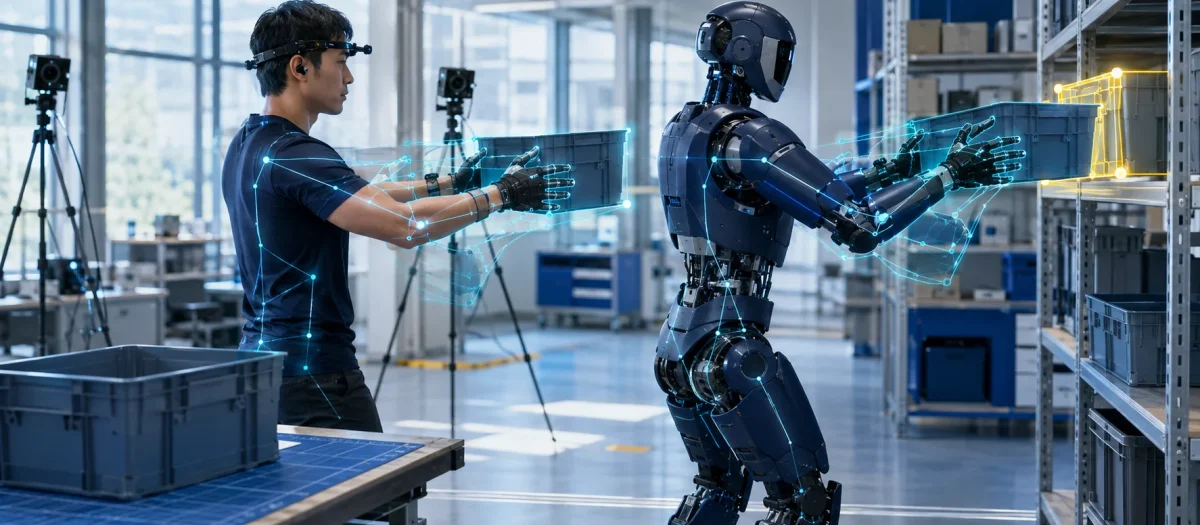
Synthesizing a robot wrist view from human head-mounted video, so a policy is rolled out from the viewpoint it will have. Research stage: WARPED reports success comparable to policies trained on teleoperated demonstrations on five tabletop tasks, at 5 to 8 times less collection time (WARPED, 2026).
Interactive assistance and mistake detection from a headset worn during a repair (HoloAssist, 2023). Research stage.
Companies
Meta Reality Labs: corporate research program. Project Aria supplies the capture hardware and perception services behind much academic egocentric collection.
Microsoft Research: corporate research lab. HoloAssist records seven synchronized streams from a mixed-reality headset during repair tasks.
University of Bristol: academic lab, maintaining EPIC-KITCHENS, a long-running unscripted egocentric benchmark.
Figure: startup, commercial pilot deployment. Helix runs from monocular onboard cameras, with a 7B vision-language model at 7 to 9 Hz driving an 80M visuomotor policy at 200 Hz.
The DROID consortium: academic collaboration that standardized a wrist plus scene camera rig across 13 institutions.
Datasets
Ego4D: 3,670 hours of daily-life activity from 931 camera wearers in 74 locations across 9 countries, with audio, 3D environment meshes, eye gaze and stereo on subsets.
Ego-Exo4D: 1,286.3 hours over 5,035 takes from 740 participants in 13 cities and 123 sites, with first-person and third-person views recorded simultaneously plus gaze, camera poses and point clouds. The paired views make view invariance measurable rather than assumed.
EPIC-KITCHENS-100: 100 hours of unscripted head-mounted kitchen activity in 45 kitchens across 4 cities, segmented into roughly 90,000 action segments over 97 verb and 300 noun classes.
HoloAssist: 166 hours from 350 instructor and performer pairs, carrying correction and intervention rather than only successful execution.
DROID: 76,000 trajectories and 350 hours across 564 scenes and 86 tasks, with calibration for 1,417 viewpoints. Its egocentric stream is the wrist camera.
Papers
WARPED: Wrist-Aligned Rendering for Robot Policy Learning from Egocentric Human Demonstrations (2026)
Active Vision Might Be All You Need: Exploring Active Vision in Bimanual Robotic Manipulation (2024)
Ego-Exo4D: Understanding Skilled Human Activity from First- and Third-Person Perspectives (2023)
HoloAssist: an Egocentric Human Interaction Dataset for Interactive AI Assistants in the Real World (2023)
Vision-Based Manipulators Need to Also See from Their Hands (2022)
Ego4D: Around the World in 3,000 Hours of Egocentric Video (2021)
Hardware
Aria Gen 2 is a current research standard for human capture, at 74 to 76 g across eight sizes, with four computer vision cameras at 120 dB dynamic range against 70 dB in Gen 1, global shutter sensors, stereo overlap widened to 80 degrees from 35 degrees, and on-device visual inertial odometry, eye tracking and articulated hand tracking (Meta, 2025). The global shutter and the HDR range answer two conditions egocentric capture creates more often than fixed capture does: fast head rotation, and a wearer walking from a lit room into a dark one inside one episode.
On the robot side the equivalent is a wrist camera such as the Zed Mini on the DROID rig, or a head camera on a humanoid. A third option is an actively controlled camera. One study mounted a ZED Mini on an extra 7-DoF arm driven by the operator’s head motion through a VR headset, at an estimated additional $6,600 in hardware, and reported higher success than static cameras alone on its occlusion-heavy tasks, including 52% against 30% on threading a needle (Chuang et al., 2024). Those are that study’s results on that bimanual platform.
Software
projectaria_tools is the reference reader for Aria recordings and the interface to Machine Perception Services, which is where the camera trajectory, point cloud, gaze and hand landmarks come from. Otherwise egocentric pipelines are assembled per project, and the components that matter are the ones that consume camera pose: a SLAM or VIO stage, a tracker that has to survive frame exits, and a writer that emits episodes into whichever dataset format the training stack expects. Multimodal Dataset Synchronization governs whether those derived streams line up with the video at all.
State of Practice
On the robot side the viewpoint question is largely settled for the platforms described here, while camera placement remains an active research problem. A systematic study across several learning algorithms, in simulation and on real hardware, found the hand-centric view improved training efficiency and out-of-distribution generalization consistently, with the caveat that this held only where the hand view was observable enough, and that adding a third-person stream to recover observability then hurt generalization again (Hsu et al., 2022). Shared platforms reflect it: DROID standardized on a wrist camera plus two scene cameras at all 13 collecting institutions, and Figure’s Helix runs from onboard cameras alone (DROID, Figure, 2025). What the third-person view is for remains contested.
On the human side, capture and derived perception have matured faster than the annotation conventions built on them. Aria Gen 2 ships gaze, hand landmarks and a 1 kHz camera trajectory as services, while the label schemas over that data still come from video understanding: narration, action segments, verb and noun classes, defined against the frames rather than against the reconstructed scene (EPIC-KITCHENS-100, Ego4D, 2021). Ego-Exo4D is the visible response, pairing every take with simultaneous third-person views so a claim about viewpoint can be tested (Ego-Exo4D).
Privacy practice has settled toward restriction. Ego4D was collected either in controlled settings with informed consent or in public with faces and other personally identifiable information blurred, and 612 hours were released unblurred only where participants consented to that specifically (Ego4D privacy statement). That is one documented pattern rather than a template the field follows, and where controlled settings are unavailable a corpus recorded in homes and workplaces carries redaction as a standing cost rather than a one-time step.
Pain Points
Labels break when the frame does. An object that leaves the view during a head turn and returns is one object to a narrator and two to a tracker, and the disagreement is invisible to per-frame quality metrics because both channels are internally consistent. Kotwel addresses this at the annotation specification stage, by deciding which channel owns identity before labeling starts.
Occlusion by the actor’s own body. The hand is most occluded at the instant it closes on an object, which is the instant the contact labels exist to describe. Rigs answer this partly in hardware through side cameras and widened stereo overlap; the residual is a review problem Kotwel could address through sampled verification of estimated poses against the frames they came from.
Bystander privacy is continuous, not incidental. A wearable camera in a home or warehouse records everyone who walks past, and the wearer’s consent does not by itself establish consent from those bystanders. Kotwel addresses redaction and anonymization of collected footage; whether a jurisdiction permits the collection belongs with the client’s counsel.
Camera pose is a dependency, not metadata. Any label defined in 3D, and any comparison across takes, is only as good as the trajectory underneath it, so a SLAM failure silently degrades every derived annotation in that interval instead of announcing itself. Reconstruction is out of scope for Kotwel; acceptance criteria on delivered episodes are in scope.
The collection viewpoint is rarely the deployment viewpoint. Head-mounted human capture and a robot wrist camera see different things at different scales, which is the gap the cross-view line of work exists to close (WARPED, 2026). Kotwel could address the labeling consequences of a view transfer; choosing the transfer method is the client’s.
Kotwel’s Role
The specification question arrives the first time an object leaves the frame and comes back. A wearer reaching for a plate glances aside for long enough that the plate leaves the frame, and the guideline has to say whether the plate before the glance and the plate after it are one labeled instance or two. Both readings are defensible. Label by world identity and the record asserts continuity across an interval no frame supports, which teaches a model object permanence and also hides how often the annotator was inferring rather than observing. Label by observation and every label stays grounded in visible evidence, at the cost of a fragmented record in which contact counts, coverage statistics and language grounding come out wrong in a way nobody notices until a policy has two names for one plate. Ego4D documents temporal free-text narrations, while EgoTracks separately annotates long-term object tracks over Ego4D videos. Kotwel works on that specification: what an instance is across frame exits, what a valid track is once camera pose is part of the signal, what evidence an annotator must have before asserting continuity, and the review that catches a corpus drifting from its own rules. Kotwel does not build robots, design capture rigs, or run collection fleets.
Egocentric data is defined by the camera being attached to the actor, which makes camera pose a signal produced by the behavior rather than a fixed property of the setup.
On robots the viewpoint question is largely settled: one systematic study found the hand-centric view improved training efficiency and out-of-distribution generalization across its algorithms and tasks, wherever that view was observable enough on its own.
On humans, capture and derived perception have outrun the annotation conventions, which are still defined against frames rather than the reconstructed scene.
The characteristic labeling failure is identity across frame exits, and it is invisible to per-frame quality checks because a narration channel and a tracker channel can each be self-consistent while disagreeing with one another.
Bystander privacy is a standing cost of wearable capture, and Ego4D’s template is consent in controlled settings or blurring in public.
Is egocentric data the same thing as human video?
No. Egocentric describes where the camera is, and human video describes who is in front of it. A robot wrist camera produces egocentric data with no human in the loop, and a fixed tripod recording a person cooking is human video that is not egocentric. They overlap in practice because the large public egocentric corpora happen to be recordings of people, which is why a dataset described only as egocentric tells you nothing about whether it contains actions a robot can use.
Do we need a wrist camera, or will a scene camera do?
Both, on the shared research rigs described in this article, with the wrist camera carrying the manipulation detail. The systematic comparison found a hand-centric view improved training efficiency and out-of-distribution generalization across a range of algorithms and settings, but only where the hand view alone was observable enough, and that adding a third-person view to recover observability then cost generalization back (Hsu et al., 2022). The shared DROID platform settled on one wrist camera plus two adjustable scene cameras (DROID).
How much labeling does an hour of egocentric video actually take?
No published per-hour cost covers this, because the driver is label density rather than duration. EPIC-KITCHENS-100 gives the order of magnitude on the dense end at roughly 900 action segments per hour, from about 90,000 segments over 100 hours, before any object track, hand pose correction or 3D annotation on top (EPIC-KITCHENS-100). What moves it is how many channels you label, whether identity has to be carried across frame exits, and how much of the derived perception you verify rather than trust.
Why does our tracker keep losing objects a person follows easily?
Because a head-mounted view moves at head speed, so objects leave and re-enter the frame constantly at changing scale and angle. That is a property of the viewpoint rather than a defect in the tracker, so the practical fix is a labeling rule: decide in advance whether re-entry creates a new instance, and record which channel, the tracker or the narration, is authoritative for identity. Without that rule the two disagree quietly and the corpus reports more distinct objects than it contains.