
Scenario Mining
How rare situations are retrieved from fleet logs long after they were recorded, why the recall of a scenario query is almost never measured, and where two defensible readings of one scenario type quietly split a corpus.
How a video frame becomes a wrist pose and gripper width, why that number is estimated rather than measured, and where the estimate breaks down at the exact contact moment a grasp label needs it most.
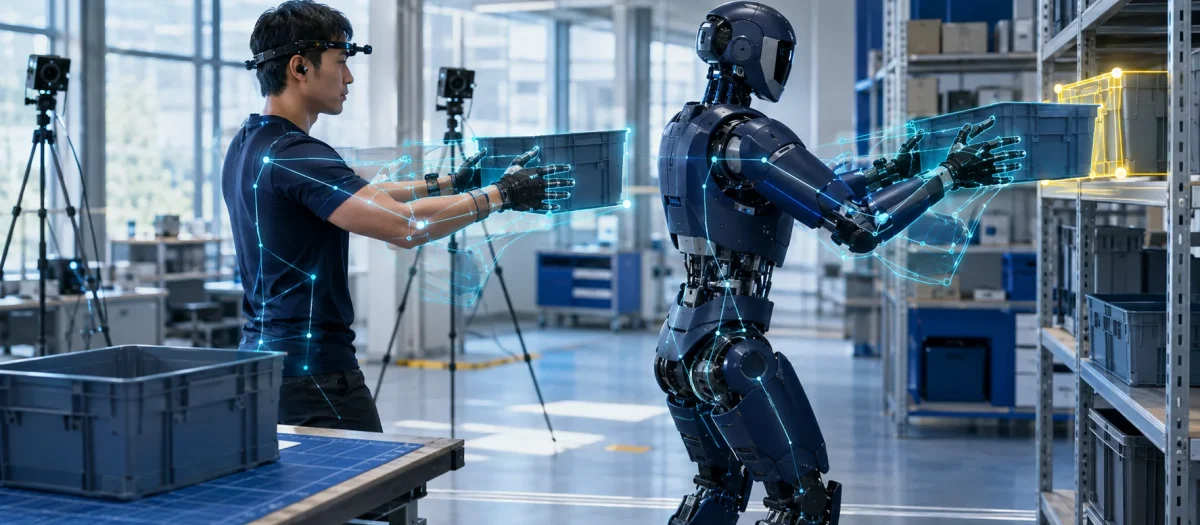
Hand pose estimation for robot learning is the computer vision step that turns a video frame of a human hand into a set of numbers: where the wrist sits in space, how the fingers are bent, and how far the fingertips have opened. It exists because a camera records where a hand went, not the joint angles or gripper command a robot policy needs to imitate, and nothing in the raw video captures that directly. It matters because hand-motion retargeting pipelines such as Ego2Robot, which train a robot on human video rather than costly teleoperation, depend on this estimate standing in for a real robot action. LAPA instead learns latent actions from video without requiring predefined action priors.
Hand pose estimation for robot learning recovers a three-dimensional description of a human hand, typically wrist position and orientation, finger joint rotation, and a derived fingertip aperture, from ordinary RGB or RGB-D video, then expresses it in a form a downstream pipeline can retarget onto a robot end-effector. Most current methods regress the parameters of a hand mesh model such as MANO from a single frame, then chain a temporal step across frames to reduce jitter and fill gaps.
Scope here covers vision-based estimation from egocentric, fixed, or multi-camera video, plus the retargeting step that converts a pose into a proxy robot action. It excludes glove and marker based motion capture, which measures joint angles directly rather than inferring them from pixels, and it excludes capture and curation of the underlying footage, which [[Human Video Data]] and [[Egocentric Data]] cover. Unlike [[Robot Demonstration Data]], where a teleoperated robot’s own encoders report its state directly, nothing here is measured; everything is inferred.
Take a frame from an unscripted egocentric recording of someone assembling a small part. A monocular estimator such as WiLoR detects the hand and regresses the 45-parameter pose and 10-parameter shape of a MANO hand mesh from that single image, along with a weak-perspective camera translation, producing 21 three-dimensional keypoints in the camera’s own frame (WiLoR, 2024). A temporal model then chains these per-frame estimates into a track to reduce jitter, since a lone-frame estimate can flip orientation between frames with nothing enforcing consistency; Ego2Robot names this refinement step DynHaMR (Ego2Robot, 2026). To make the hand executable by a parallel jaw gripper, the pipeline defines a virtual fingertip as a weighted blend of the index and middle fingertips, roughly seventy percent index and thirty percent middle, then derives a tool center point and gripper opening width from the thumb and that virtual point (Ego2Robot, 2026).
The failure sits at the moment the label exists to describe. As fingers close around an object, the hand self-occludes and is partly hidden behind the object itself, so the per-frame estimate is least constrained exactly when the gripper width needs to be most precise. Ego2Robot treats a gripper width collapsing below one centimeter as a degenerate case and freezes the grasp orientation to the last valid estimate rather than trust the frame (Ego2Robot, 2026), which repairs the symptom rather than the estimate. The downstream consequence is that the contact frame, the single moment a grasp-imitation policy most needs to learn from, is the frame most likely to carry a corrected value rather than an observed one.
Retargeting human video into proxy robot actions for cross-embodiment co-training. Research stage; Ego2Robot reports amplifying roughly 1,940 hours of hand-annotated egocentric footage into 18,561 hours of synthesized trajectories across fifteen robot morphologies (Ego2Robot, 2026).
Real-time dexterous teleoperation, where an operator’s live hand pose drives a robot hand rather than being recorded for later training. Research to early production; AnyTeleop retargets the same vision pipeline across four different robot hand embodiments (AnyTeleop, 2023).
Benchmark construction, where a multi-camera rig produces a pseudo ground truth a monocular estimator is measured against. Research stage; AssemblyHands fused several exocentric views over existing footage to cut mean keypoint error to 4.20 millimeters, an 85 percent reduction from the source dataset’s original single-view labels (AssemblyHands, 2023).
World-space hand and camera trajectory reconstruction, recovering where a hand moved relative to the room rather than relative to a moving headset. Research stage (HaWoR, 2025).
Consumer augmented and virtual reality hand interaction. Production deployment, but not built for robot learning: the error tolerance for selecting a menu item is looser than the tolerance for a grasp label a policy will imitate.
Google: production, open source. MediaPipe Hands is the real-time, on-device 21-keypoint detector several dexterous teleoperation stacks use as their vision front end.
Meta: research hardware and research program. Project Aria and Aria Gen 2 output hand tracking as a first-class stream, and Meta co-authors the egocentric datasets these estimators are trained and evaluated on.
Microsoft Research: corporate research lab. VITRA runs a fully automated hand and camera motion pipeline over unscripted internet-scale hand video to build training corpora rather than a live product.
NVIDIA: research lab, teleoperation tooling. DexPilot and its successor AnyTeleop, built with UC San Diego, are cited as reference retargeting systems across the dexterous teleoperation literature (AnyTeleop, 2023).
dexsuite: open source, community maintained. The dex-retargeting library packages a keypoint-vector optimization approach into a reusable tool for mapping human hand motion onto arbitrary robot hand URDFs.
FreiHAND: single-hand RGB benchmark used to evaluate monocular estimators such as WiLoR and HaMeR.
HO3D: hand-object interaction video with pose annotations.
DexYCB: multi-camera RGB-D recordings of hand grasping over YCB objects, with pose ground truth from multi-view fitting rather than a single camera; also used as an occlusion-heavy evaluation set in HaWoR (HaWoR, 2025).
AssemblyHands: 3.0 million annotated images, including 490,000 egocentric frames, with 3D labels generated by fusing synchronized exocentric views rather than by manual egocentric annotation (AssemblyHands, 2023).
HOT3D: egocentric video from Aria and Quest 3 headsets with hand and object poses anchored to a professional optical marker motion-capture system, one of a small number of settings where hand pose is closer to measured than estimated (HOT3D, 2024).
Ego2Robot: Scalable Robot Data Synthesis from Egocentric Human Data (2026)
HaWoR: World-Space Hand Motion Reconstruction from Egocentric Videos (2025)
HOT3D: Hand and Object Tracking in 3D from Egocentric Multi-View Videos (2024)
WiLoR: End-to-end 3D Hand Localization and Reconstruction in-the-wild (2024)
AnyTeleop: A General Vision-Based Dexterous Robot Arm-Hand Teleoperation System (2023)
AssemblyHands: Towards Egocentric Activity Understanding via 3D Hand Pose Estimation (2023)
DexYCB: A Benchmark for Capturing Hand Grasping of Objects (2021)
DexPilot: Vision-Based Teleoperation of Dexterous Robotic Hand-Arm System (2020)
Real-time teleoperation needs an estimator that fits inside the control loop: MediaPipe Hands runs on a CPU at interactive frame rates, which is why AnyTeleop builds on it rather than a heavier offline model (AnyTeleop, 2023). Corpus construction has the opposite constraint: WiLoR-class monocular models and their temporal refinement run offline, batched over however many hours of footage a project has, so compute cost scales with video hours rather than with episode count. Ground truth capture is a third regime again: HOT3D pairs Aria and Quest 3 headsets with a marker-based motion-capture rig to record a hand pose no vision model estimates, which is practical in a lab and not in an unscripted recording (HOT3D, 2024).
Some pipelines chain a per-frame detector such as WiLoR against a MANO parametric hand model, then a temporal refinement stage; Ego2Robot names its stage DynHaMR (Ego2Robot, 2026). Retargeting the resulting keypoints onto a robot hand is handled by an optimizer such as dex-retargeting, which minimizes the distance between human and robot keypoint vectors and needs finger correspondences specified by hand whenever the robot hand is not arranged like a human’s (AnyTeleop, 2023). Segmentation models such as SAM are used downstream of the estimate itself, not to find the hand but to check it: Ego2Robot discards a frame when most of its projected keypoints fall outside the hand’s own segmentation mask (Ego2Robot, 2026).
Two different problems both get called hand pose estimation, and the field has not converged on treating them separately. Inside a rig with several synchronized cameras or a marker-based system, the pose is close to measured: HOT3D anchors its labels to an optical marker system precisely because vision alone is not trusted as ground truth (HOT3D, 2024), and AssemblyHands only reached a 4.20 millimeter mean keypoint error by fusing several exocentric views, an 85 percent improvement over the dataset’s original single-view labels (AssemblyHands, 2023). Outside that rig, on a single egocentric camera in an unscripted setting, no such ground truth exists at collection time, and pipelines fall back to internal consistency checks instead of accuracy: mask overlap, frame-to-frame velocity limits, and degenerate-case detection when a gripper width estimate collapses (Ego2Robot, 2026).
The retargeting step once a track exists has not converged on one construction, and it depends on the embodiment. For a parallel gripper, Ego2Robot defines a contact point from a weighted combination of fingertips, derives a gripper width and orientation from it, and smooths the result temporally. For a dexterous hand, AnyTeleop instead minimizes the difference between human and robot hand keypoint vectors, with a penalty term for temporal smoothness. Temporal smoothing is the shared element, in different forms, and the confidence policy around both remains unsettled (Ego2Robot, 2026; AnyTeleop, 2023).
No ground truth outside a lab rig. In an unscripted recording there is nothing to check an estimate against except itself, so the confidence signals in use tell you the estimate is internally consistent, not that it is correct.
Self-occlusion peaks at the contact moment. As fingers close on an object the hand hides itself behind it, so confidence in the estimate falls exactly where a grasp-imitation signal needs it most, and the standard repair substitutes a stale value for the frame training depends on most (Ego2Robot, 2026).
Retargeting discards grasp information the source hand had. Reducing five independently moving fingers to a single gripper width erases the difference between a pinch and a full-hand wrap, and nothing in the pixel data marks which grasps survive the reduction. This is a limit of the target hardware rather than an estimation error.
Coordinate frames do not travel with the pose. An estimate is native to the camera’s frame at capture time, and turning it into a usable robot action needs a hand-eye or camera-to-robot calibration step that [[Robot Calibration and Coordinate Frames]] covers in depth.
Privacy in the source footage compounds the problem rather than following from it. Hands are less immediately recognizable than a face, but the frames a pipeline processes still contain faces, license plates, and home interiors, and none of the occlusion or velocity checks above touch that footage.
Kotwel is the data-quality and data-operations partner for Physical AI. We turn multimodal physical-world and synthetic data into synchronized, structured, validated, and traceable datasets for training, evaluation, and continuous improvement. We make consequential data choices explicit and develop measurable quality criteria that enable organizations to benchmark and improve the data behind physical AI systems.
Kotwel works at the data layer and remains independent of hardware, sensing architecture, and model family. We define data-quality criteria, audit datasets, and assess conformance against documented requirements. Clients retain control over program-specific conventions, intended model behavior, and operating requirements, provided those choices are explicitly documented and consistently applied. We do not build robots or autonomy stacks, develop control systems, or train foundation models. Decisions about system safety, legal compliance, and deployment remain with the client and its qualified advisers.
The specification question arrives at exactly the frame Pain Point two names: a gripper width estimate has just collapsed because the hand closed around an object and the model lost the fingers behind it, and something has to occupy that timestep before the episode can be written. Ego2Robot freezes only the grasp orientation to the last valid estimate when gripper width falls below 0.01 m, which keeps the trajectory continuous, as a shared action decoder needs. The Ego2Robot main text describes validity flags as applied during data curation and does not say they reach the training sample, so a copied-forward orientation may be indistinguishable from an observed one. Discarding or masking the frame is honest about the gap but leaves a hole exactly where a contact-sensitive policy needs reliable supervision, and nothing in the raw video marks which choice a given training setup can tolerate. Kotwel works on that specification: making explicit the agreed confidence threshold below which a frame is flagged rather than trusted and the agreed handling for a flagged frame, whether frozen, interpolated, or dropped for a given use, and running the sampled review against source video that catches a pipeline’s confidence checks drifting from what the frames actually show. Kotwel does not build the hand pose estimator, choose the retargeting geometry, or set the threshold itself, which depends on the hardware, model and program.
A hand pose estimate is computed from pixels, not measured, and confidence in it is lowest exactly at the contact moment a grasp label exists to describe.
Ground truth for hand pose exists only inside a rig with multiple synchronized cameras or a marker-based motion-capture system; in the wild, pipelines substitute internal consistency checks for accuracy.
Retargeting a five-fingered hand onto a parallel jaw gripper discards grasp information, and nothing in the source video marks which grasps survive the reduction.
Independent pipelines converge on a similar retargeting construction, a weighted contact point, a derived gripper width, and temporal smoothing, even while the policy for handling a flagged frame remains unsettled.
What to do with a low-confidence frame, freeze it, interpolate it, or drop it, is a specification decision, not a solved engineering problem.
HaWoR reports 4.76 millimeters of mean per-joint error on a marker-based benchmark, and AssemblyHands reports 4.20 millimeters after fusing several camera views (HaWoR, 2025; AssemblyHands, 2023). Both figures come from a rig with multiple cameras or physical markers supplying ground truth, and neither applies to a single egocentric camera recording unscripted footage: there, no ground truth exists, and a pipeline reports a confidence signal, such as mask overlap or velocity consistency, instead of an error against truth.
No. A joint encoder measures the robot’s own commanded and executed state directly, while a hand pose estimate infers a person’s pose from pixels and then approximates a robot action from it. [[Robot Demonstration Data]] never needs this estimation step, since a teleoperated robot already reports its own state; hand pose estimation exists specifically for footage where no robot was present to report anything.
The estimate for that frame becomes unreliable rather than absent, since most pipelines still output a number even at low confidence, and it is the pipeline’s job to flag that number rather than the number’s job to announce its own unreliability. Current approaches either freeze the last confident estimate (Ego2Robot, 2026) or run a motion-infilling model that reconstructs the missing span in a canonical, camera-independent space (HaWoR, 2025). Neither recovers the true pose; both produce a plausible one.
One egocentric camera is enough to produce a usable estimate for training data, and it is not enough to produce a verified one. A single monocular estimator such as WiLoR is what most in-the-wild pipelines run because a single camera is usually all that is available, while multi-camera and marker-based rigs such as HOT3D exist to generate the ground truth those monocular estimators are validated against, not to serve as the production pipeline itself (HOT3D, 2024).