AI Data Reliability for Production AI and Robotics Systems

Kotwel supports AI and robotics teams by connecting raw telemetry, annotation workflows, QA validation, and production model behavior into a reliable operational pipeline.

We provide the human-in-the-loop data reliability layer required to validate edge cases, stabilize multimodal inputs, calibrate reviewers, and convert field failures into governed dataset improvements.
Temporal QA: label stability across video, LiDAR, sensor streams, and sequential robotics data.

Sensor-alignment validation: review workflows for spatial offsets and cross-modal inconsistency in fused inputs.

Feedback engineering: production failure logs converted into relabeling queues, taxonomy changes, and validation updates.

AI data reliability pipeline for production AI systems

The PRISM Reliability Model

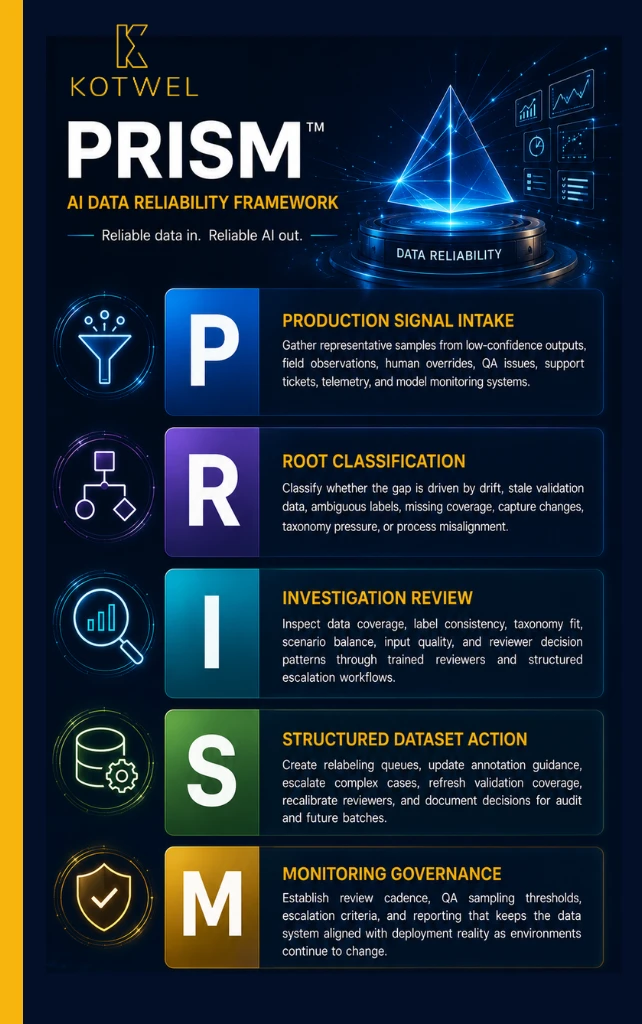
PRISM is Kotwel's core operating framework for AI data reliability.

Kotwel organizes data reliability operations around the PRISM Reliability Model — a five-stage operating framework covering production signal intake, root classification, investigation review, structured dataset action, and monitoring governance. Each stage feeds the next; a gap in any one creates compounding risk across the production data system.

(P) Production Signal Intake

Gather representative samples from low-confidence outputs, field observations, human overrides, QA issues, support tickets, telemetry, and model monitoring systems.

(R) Root Classification

Classify whether the gap is driven by drift, stale validation data, ambiguous labels, missing coverage, capture changes, taxonomy pressure, or process misalignment.

(I) Investigation Review

Inspect data coverage, label consistency, taxonomy fit, scenario balance, input quality, and reviewer decision patterns through trained reviewers and structured escalation workflows.

(S) Structured Dataset Action

Create relabeling queues, update annotation guidance, escalate complex cases, refresh validation coverage, recalibrate reviewers, and document decisions for audit and future batches.

(M) Monitoring Governance

Establish review cadence, QA sampling thresholds, escalation criteria, and reporting that keeps the data system aligned with deployment reality as environments continue to change.

Common Production AI Reliability Challenges

Many AI systems perform well in controlled testing but become less reliable as deployment environments evolve. In practice, these challenges often emerge from the operational layer surrounding the model: data sources, annotation guidelines, validation sets, review workflows, and production feedback systems.

Annotation Drift Across Batches

Label quality can gradually shift as guidelines evolve, edge cases expand, and reviewer interpretation varies across teams and time periods. Small inconsistencies can accumulate into measurable differences in model behavior and evaluation stability.

Validation Set Degradation

Evaluation datasets that once reflected production conditions can become less representative as users, environments, sensors, products, and workflows change after deployment.

Edge-Case Review & Escalation

Ambiguous or low-frequency scenarios often require structured escalation workflows. Without expert review coverage, these cases can lead to inconsistent labeling, unresolved taxonomy boundaries, and reduced validation consistency.

Production Feedback Loop

Teams may collect telemetry and field feedback without a clear process for turning those signals into relabeling queues, guideline revisions, validation updates, and dataset improvements.

Production AI Systems Need a Data Reliability Layer

Once a model is deployed, reliability depends on more than model architecture. Annotation guidelines can drift, validation sets can become stale, reviewer interpretation can split across teams, and production signals may never reach the dataset owners. A data reliability layer keeps annotation, validation, drift review, and feedback operations connected to the environment where the model actually runs.

Labeling Consistency

Guidelines, reviewer calibration, sampling, consensus review, and correction workflows keep labels aligned across teams, batches, tools, and time.

Without calibration systems, annotation standards gradually diverge across reviewers and projects. Small interpretation differences accumulate into inconsistent labels, unstable validation results, and unreliable retraining data.

Data Drift Review

After launch, production environments rarely remain stable. Kotwel helps identify new scenarios, ambiguous cases, sensor variation, field-data gaps, and dataset shifts that weaken model performance.

Production AI systems often fail because new environmental conditions never reach the training pipeline. Drift review operations help convert field observations, telemetry anomalies, and edge-case failures into governed dataset updates.

Human Validation

Human-in-the-loop review identifies ambiguous predictions, taxonomy conflicts, low-confidence outputs, and recurring failure patterns before they propagate into production workflows or retraining cycles.

Automated QA systems can detect structural errors, but they struggle with ambiguity, multimodal inconsistency, and edge-case interpretation. Human review remains critical for escalation handling, validation governance, and production reliability oversight.

Operationalizing AI reliability at scale

Reliability Operations Workflow

1. Define Reliability Criteria

Clarify the model task, data sources, taxonomy, quality bar, risk areas, review rules, escalation criteria, reporting needs, and delivery format.

2. Calibrate Annotation and Review

Train annotators and reviewers around examples, edge cases, disagreement patterns, taxonomy boundaries, tool-specific requirements, and expected QA evidence.

3. Monitor Dataset Quality

Use structured QA sampling, reviewer agreement monitoring, IAA signals, corrections, blocker logs, issue categories, SME escalation paths, and reviewer feedback to keep batches consistent.


QA sampling is typically structured at 10–20% of batch volume during calibration phases, adjusting based on reviewer agreement rates, issue frequency, and the risk tolerance of the model task.

4. Close the Model Feedback Loop

Convert recurring production model failures into structured relabeling queues, taxonomy revisions, edge-case review tasks, validation-set updates, and annotation guideline improvements.

KOTWEL

THE AI AND ROBOTICS DATA OPERATIONS RELIABILITY PARTNER

Data Reliability Operations

What AI Data Reliability Means at Kotwel

Data quality is often treated as a pre-training milestone, but production models operate in environments that keep changing: new sensor configurations, updated user behavior, expanded task definitions, and edge cases that did not exist at launch. Annotation decisions that were correct six months ago may no longer reflect what the model needs to handle today. AI data reliability is the operating discipline that keeps the data system synchronized with the production environment.

Kotwel works as an AI/robotics data operations reliability layer for teams that need more than labeling capacity. We help organize the people, QA process, review criteria, escalation paths, and reporting structure behind datasets that must support production decision-making.

Why automated QA alone is not enough for multimodal and robotics systems?

Automated checks catch volume-level label errors: missing annotations, format violations, and obvious outliers. They do not resolve taxonomy disagreements between reviewers, subtle temporal inconsistency across frames, sensor-alignment errors in fused inputs, or context-dependent edge cases. For production robotics and multimodal systems, human review is not a fallback; it is the reliability layer that resolves ambiguity automation cannot classify.

Reliable Training Data

Clear taxonomies, calibrated instructions, consistent annotation, and QA loops that reduce noisy labels.

Reliable Validation Data

Review-ready benchmark sets, edge-case samples, and evaluation data that teams can trust.

Reliable Human Operations

Managed annotators, reviewers, project leads, and reporting systems built around measurable quality.

Reliable Production Feedback

Model errors, drift signals, and field observations converted into dataset improvements.

Enterprise Data Operations

Production-oriented reliability operations

At Kotwel, we support scalable AI data operations with structured QA sampling, reviewer agreement monitoring, escalation paths, issue categorization, validation traceability, and reporting designed for operational accountability.


Our review systems support both early-stage datasets and continuous production feedback pipelines while maintaining consistent governance, escalation logic, and review traceability across changing scale and complexity.

Production AI Starts With Reliable Data

Annotation governance and reviewer calibration

QA thresholds, sampling plans, and correction workflows

Edge-case escalation and issue categorization

Validation-set review and benchmark readiness

Audit-ready reporting for dataset decisions

Production feedback loops for continuous improvement

Find out how reliable data operations can improve your production AI system

Production Reliability Scenario

Navigation model degradation after environment expansion

A robotics navigation model trained on warehouse layouts began misclassifying elevator transition zones after deployment into multi-floor environments. Production intervention logs revealed repeated hesitation events around transitional spaces absent from the original training distribution.

Kotwel structured a targeted review workflow using intervention telemetry, escalated ambiguous cases to SME review, identified annotation inconsistency in boundary-transition labels, and introduced a revised taxonomy for transitional-space classification.

Reliability Operations Triggered

  • Intervention telemetry ingestion
  • Edge-case review queue creation
  • Reviewer calibration update
  • Taxonomy revision
  • Validation-set reconstruction
  • Relabeling workflow deployment

Reliability Workflow Outcome

Production reliability signals were investigated using the PRISM Reliability Model:

signal intake → root classification → investigation review → dataset action → monitoring governance

Operational Results

18%

Reviewer disagreement detected

4

New edge-case scenarios identified

146

Escalated review cases

+12%

Validation-set coverage increase

96%

Post-calibration reviewer agreement

Related AI Reliability Domains

AI data reliability depends on connected operational systems across validation workflows, human review, robotics data operations, multimodal synchronization, and production feedback pipelines. These related domains support the governance, QA, and lifecycle management required for dependable production AI systems.

Data Drift

Production environments change after deployment. Data drift explains how new user behavior, sensor variation, content shifts, and field conditions affect model reliability.

Understand Data Drift →

Dataset Quality

Reliable AI systems depend on datasets that are complete, consistent, representative, and maintained through structured quality and validation standards.

Review Dataset Quality →

Production AI Challenge

How production AI issues often originate from dataset gaps, validation drift, feedback disconnection, and operational inconsistency.

Analyze Production Reliability →

Robotics AI Data

Robotics systems introduce temporal consistency, sensor fusion, spatial reasoning, and field-feedback challenges that require specialized reliability operations.

Explore Robotics Reliability →

Human-in-the-Loop Validation

Human review supports ambiguity resolution, escalation handling, reviewer calibration, and validation governance for production AI systems.

View Validation Workflows →

Multimodal AI Systems

Multimodal AI requires synchronized data workflows across text, image, video, audio, and sensor inputs throughout production environments.

Navigate Multimodal Systems →

Frequently Asked Questions (FAQs)

Top Questions We Get Asked Most Often About AI Data Reliability

FAQ illustration for Kotwel AI data services

Have more questions? Please get in touch with us, we will gladly answer your questions.