

Data Flywheel: How Compounding Data Creates Better Products
Learn how usage data, feedback loops, and disciplined experimentation can compound into better products, stronger retention, and a defensible competitive advantage.
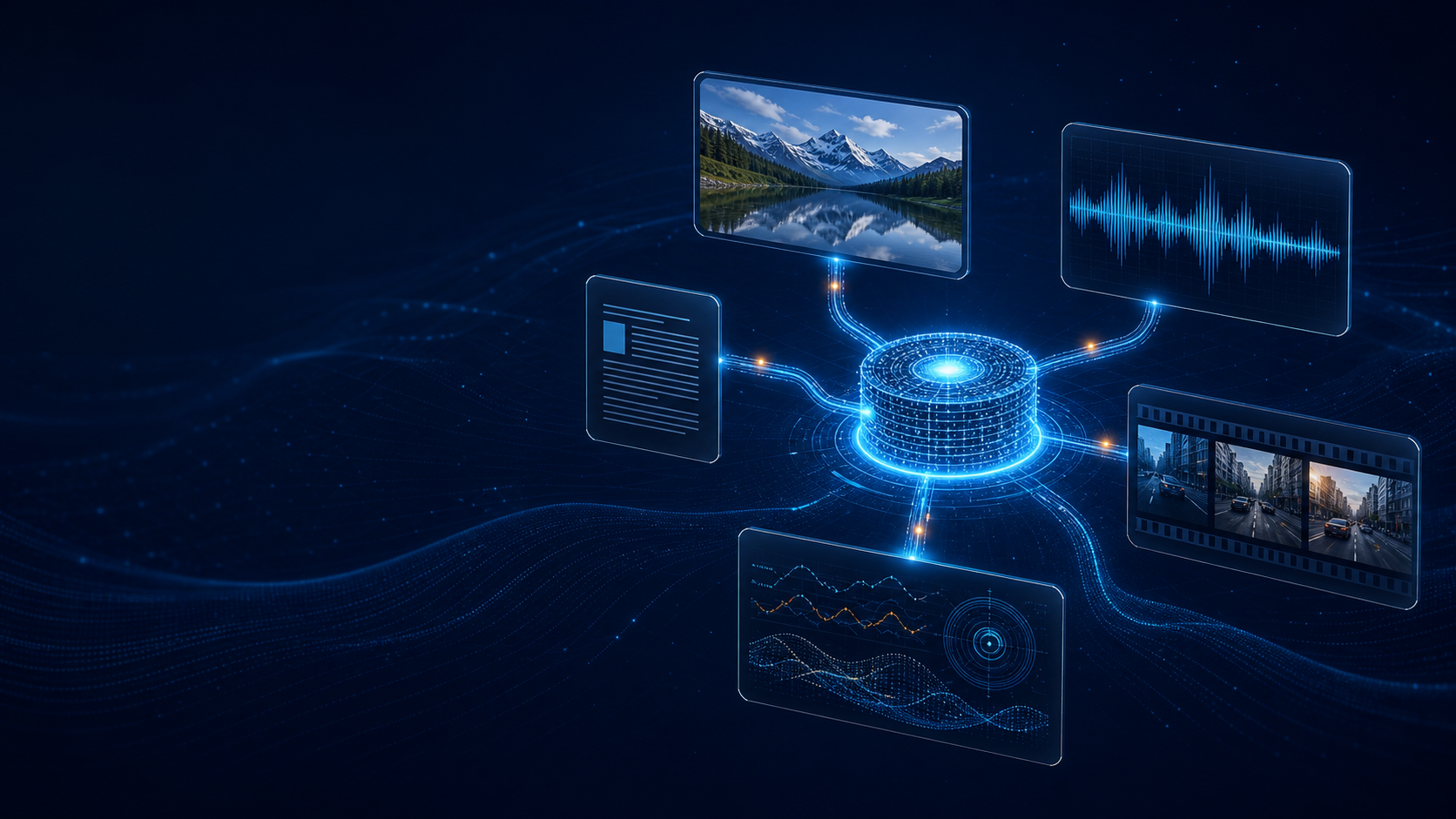
→Multimodal AI systems learn from several kinds of evidence at once, but simply collecting more files does not produce a reliable dataset. The useful unit is a traceable, synchronized sample whose image, audio, text, video, and sensor records describe the same event.
A multimodal training dataset combines two or more data types that share a meaningful relationship. A warehouse-robot sample, for example, might contain a camera frame, a spoken instruction, a barcode transcription, proximity readings, and the action selected by the robot.
Key point: modalities should be connected by a stable sample identifier and a documented time window. Files that happen to come from the same project are not necessarily aligned training data.
Dataset quality is a system property: collection, synchronization, annotation, validation, and governance must reinforce one another.
One modality can resolve ambiguity in another. An image may show a person near a machine, while audio and telemetry reveal whether the machine is idle, starting, or operating under load.
Aligned evidence makes it possible to test whether a model is using the intended signals instead of learning shortcuts. Teams can remove or corrupt one modality and measure how predictions change.
Real systems encounter missing, delayed, noisy, and contradictory inputs. Recording those conditions during dataset creation produces more realistic validation sets and clearer fallback requirements.
External guidance: the NIST AI Resource Center provides resources for testing, evaluation, verification, and validation across the AI lifecycle.
Text: instructions, transcripts, labels, descriptions, and structured metadata.
Images: RGB frames, depth maps, thermal captures, diagrams, and document scans.
Audio: speech, alarms, ambient sound, machinery, and acoustic events.
Video: temporal sequences that preserve movement and changes in context.
Sensors: LiDAR, GPS, force, temperature, telemetry, and device state.
Every sample should make its relationships explicit instead of relying on filenames or folder position. Store timestamps in one reference clock, preserve the original source identifiers, and record any transformation applied before training.
{
  "sample_id": "mm-warehouse-0042",
  "captured_at": "2026-07-21T08:14:32.120Z",
  "modalities": ["image", "audio", "telemetry"],
  "alignment_tolerance_ms": 20,
  "annotation_version": "2.1",
  "review_status": "approved"
}Define the decision: document what the model must predict or generate and which operating conditions matter.
Design the sample: specify required modalities, clocks, identifiers, consent records, and acceptable missing data.
Collect representative events: include common behavior, difficult edge cases, and foreseeable failure conditions.
Synchronize and annotate: align records before labeling so reviewers see the same evidence the model will receive.
Validate and version: check integrity, agreement, coverage, and leakage before promoting a dataset release.
Practical tip: manually inspect a small set of complete samples before scaling collection. A ten-minute review can expose clock drift, ambiguous labels, or missing provenance that would otherwise affect thousands of records.
| Control | What to measure | Example acceptance target |
|---|---|---|
| Alignment | Difference between modality timestamps | 95% within the declared tolerance |
| Completeness | Required files and metadata present | At least 99% of approved samples |
| Agreement | Independent reviewers selecting the same label | Threshold set per task and risk level |
| Coverage | Representation across environments and edge cases | No critical scenario omitted |
| Traceability | Source, consent, transformation, and review history | Complete lineage for every released sample |
Data quality problems can affect the accuracy and interpretation of machine-learning results. Google’s data-quality guide highlights inaccuracies, bias, collection methods, and preprocessing as important considerations.
Independent devices slowly disagree about time, so apparently matching records describe different moments. Monitor drift during collection instead of correcting everything after the session.
A sensor can stop reporting while the rest of the pipeline continues. Record explicit missingness rather than substituting a zero value that could be mistaken for a real measurement.
Frames from the same sequence, speaker, site, or device can enter both training and evaluation splits. Split by the real unit of independence—not by individual files.
Technically useful data may still be unsuitable for training. Preserve the permitted uses, retention limits, geographic restrictions, and required deletion process with the dataset.
The intended model decision and operating context are documented.
Every modality has an owner, schema, clock, and quality threshold.
Samples preserve source identifiers and transformation history.
Edge cases and foreseeable failure conditions are represented.
Evaluation groups are isolated from training groups.
Privacy, consent, licensing, and retention requirements are verified.
The dataset version can be reproduced from controlled inputs.
Ready for review: release the dataset only when another team can understand what it contains, reproduce its checks, and identify which model uses are supported or unsupported.
For help planning collection, annotation, or validation, visit the Kotwel website.
