

Robotics AI Data Operations
Sensor Fusion Data for Production Robotics Systems
At Kotwel, we support robotics and embodied AI teams with sensor fusion data operations that keep camera, LiDAR, depth, IMU, telemetry, and human-reviewed labels aligned across collection, annotation, QA, validation, and production feedback.
We apply the PRISM Reliability Model to support teams governing multimodal sensor data under real deployment conditions, where timing, spatial reference, calibration context, reviewer judgment, and validation coverage all affect production reliability.
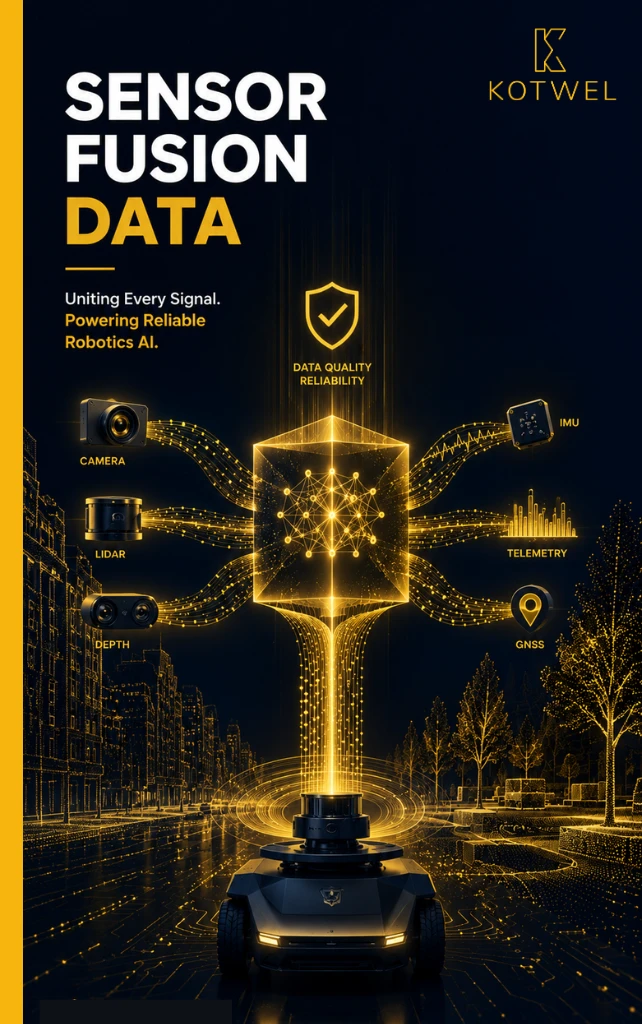
Sensor Fusion Data Operations Built for Real Deployment Conditions
Robotics systems depend on multiple data streams that must describe the same physical world. At Kotwel, we organize the review, QA, validation, and feedback workflows that maintain data reliability as environments, conditions, and edge cases evolve.
Multimodal Data Preparation
Prepare synchronized sensor data for downstream review and training workflows.
Support for synchronized sensor captures, calibration files, metadata, timestamps, and robotics-specific data formats used across multimodal AI pipelines.
Annotation QA
Maintain labeling consistency across sensors, reviewers, and edge cases.
Sensor fusion annotation requires spatial, temporal, and cross-modal judgment. Structured QA workflows, reviewer calibration, and escalation paths improve labeling consistency and operational control.
Validation Review
Keep evaluation coverage aligned with deployment reality.
Validation workflows are structured around current operating conditions, helping teams assess performance against representative sensors, environments, and real-world edge cases.
The PRISM Reliability Model
PRISM is Kotwel's core operating framework for AI and robotics data reliability. In sensor fusion programs, PRISM provides a repeatable path from field observation to governed multimodal dataset correction.
Kotwel organizes sensor fusion data operations around the PRISM Reliability Model, covering production signal intake, root classification, investigation review, structured dataset action, and monitoring governance. Each stage helps teams determine whether the reliability variance comes from sensor capture changes, synchronization gaps, taxonomy pressure, validation coverage, reviewer drift, or field-data expansion.
Build sensor fusion data operations around production reliability
Where Sensor Fusion Data Reliability Becomes Operationally Important
Sensor fusion data reliability matters most when robots depend on aligned multimodal evidence to make decisions under changing physical conditions.
Perception and Scene Understanding
Object boundaries, occlusion, reflective materials, lighting shifts, camera placement, and rare object states require consistent review rules and production-aware validation coverage.
Manipulation and Task Execution
Picking, placement, inspection, assistance, and tool-use tasks depend on object state, motion sequence, pose, contact context, and calibrated human interpretation.
Enterprise AI Programs
Robotics data programs are part of a larger picture. Kotwel aligns model development, review workflows, QA, and data governance across your entire AI initiative.
Navigation and Spatial Reasoning
Robots encounter new layouts, transition zones, surface changes, sensor offsets, and route conditions. These signals need structured review before they become recurring reliability variance.
Production Feedback Loops
Field interventions, manual overrides, low-confidence outputs, QA observations, and monitoring signals become more useful when routed into clear dataset improvement actions.
Robotics Data Programs
Sensor fusion workflows are part of broader robotics data operations spanning collection, annotation, validation, QA, and field feedback governance.
Ready to make sensor fusion data operations more reliable?
Frequently Asked Questions (FAQs)
Top Questions We Get Asked Most Often About Sensor Fusion Data Operations for Robotics AI Systems.

Have more questions? Please get in touch with us, we will gladly answer your questions.