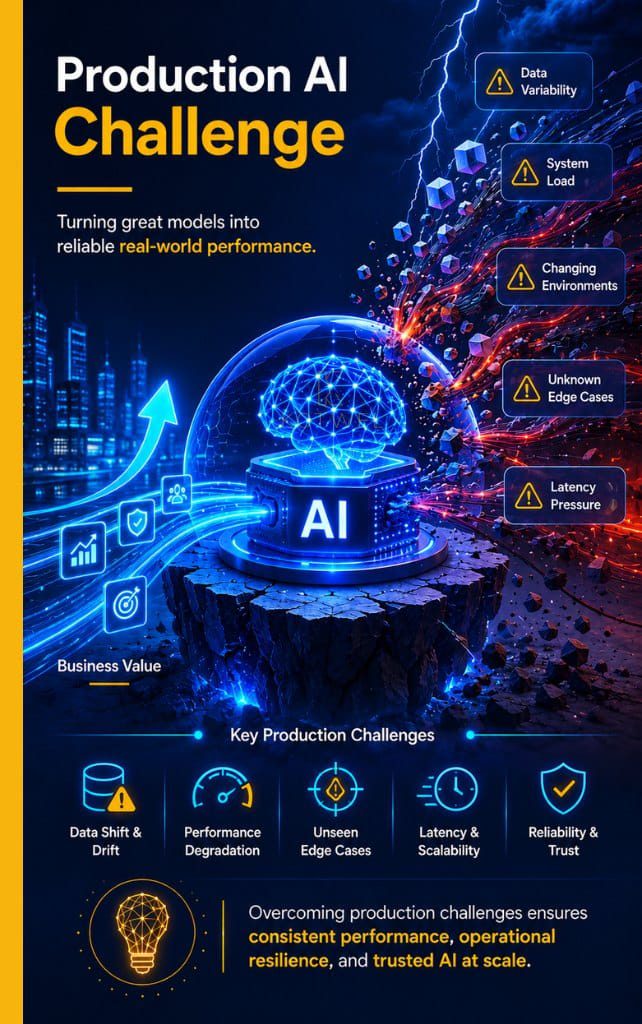
Production AI Challenge

When Production AI Behaves Inconsistently

AI and robotics systems often pass controlled evaluation, then show quality variance once they encounter new users, environments, sensors, or edge cases.

Kotwel investigates the data operations behind those gaps and converts production signals into governed dataset improvement, using the PRISM reliability model.
Production behavior review: Inspect low-confidence outputs, human interventions, field observations, and recurring issue categories routed into same-week review queues.

Dataset reliability analysis: Evaluate annotation consistency, data coverage, taxonomy fit, validation freshness, and QA evidence.

Governed improvement workflows: Turn unresolved cases into relabeling queues, calibration batches, validation refresh cycles, and auditable reporting for engineering and operations leaders.

Kotwel AI Production Challenge

The PRISM Reliability Model

PRISM is Kotwel's core operating framework for AI data reliability. The Production AI Challenge enters the framework most directly at the (S) Structured Dataset Action stage. Once production systems begin showing reliability gaps, intervention patterns, edge-case failures, or inconsistent model behavior, teams need structured operational workflows to convert those signals into governed dataset improvement. Structured action determines whether the response requires relabeling, reviewer recalibration, validation-set restructuring, taxonomy refinement, escalation review, or deployment-specific dataset correction.

Kotwel organizes data reliability operations around the PRISM Reliability Model — a five-stage operating framework covering production signal intake, root classification, investigation review, structured dataset action, and monitoring governance. Each stage feeds the next; a gap in any one creates compounding risk across the production data system.

(P) Production Signal Intake

Gather representative samples from low-confidence outputs, field observations, human overrides, QA issues, support tickets, telemetry, and model monitoring systems.

(R) Root Classification

Classify whether the gap is driven by drift, stale validation data, ambiguous labels, missing coverage, capture changes, taxonomy pressure, or process misalignment.

(I) Investigation Review

Inspect data coverage, label consistency, taxonomy fit, scenario balance, input quality, and reviewer decision patterns through trained reviewers and structured escalation workflows.

(S) Structured Dataset Action

Create relabeling queues, update annotation guidance, escalate complex cases, refresh validation coverage, recalibrate reviewers, and document decisions for audit and future batches.

(M) Monitoring Governance

Establish review cadence, QA sampling thresholds, escalation criteria, and reporting that keeps the data system aligned with deployment reality as environments continue to change.

Root Cause Taxonomy

The Four Production Data Gaps

Most production AI failures trace back to one of four data system gaps, not model architecture. Controlled testing rarely surfaces them because they typically emerge only when the system encounters distribution conditions outside the assumptions and coverage of the original dataset design.

Gap 01

Coverage

The deployed system encounters regions, conditions, objects, users, or device states that were not sufficiently represented during dataset preparation. Coverage review identifies which scenarios are missing, where representation is weak, and whether the issue stems from complete absence or from distribution imbalance relative to real-world operating frequency.

Gap 02

Annotation Consistency

Production cases reveal that the label taxonomy does not fully reflect the real decision space, creating inconsistent handling of ambiguous samples across reviewers and QA layers. The key diagnostic signal is inter-annotator agreement measured at the label-class level, where class-specific inconsistency remains visible instead of being diluted by overall dataset averages.

Gap 03

Validation Staleness

Evaluation sets that were representative at launch become less aligned as deployment conditions evolve. Metrics may still appear healthy while the validation set no longer reflects the environments, behaviors, or edge cases most active in production. Drift-triggered refresh cycles help maintain alignment between evaluation coverage and real-world deployment conditions.

Gap 04

Feedback Disconnection

Logs, manual interventions, user reports, QA findings, and low-confidence outputs are collected but not consistently routed into annotation, validation, or dataset governance workflows. As production signals accumulate without structured review cycles, the operating environment gradually diverges from the dataset assumptions used during training, increasing the need for coordinated dataset refresh and calibration.

How One Data Gap Propagates

Consider a sensor change at a new deployment site. A camera angle adjustment that appears minor at the hardware level can influence the entire data system: the new capture conditions extend beyond the original training coverage (Gap 01: Coverage), reviewers encounter unfamiliar samples and interpret label boundaries differently (Gap 02: Annotation Consistency), the validation set reflects earlier visual conditions rather than the updated environment (Validation Staleness), and low-confidence outputs accumulate without a structured workflow connecting them back to dataset operations (Feedback Disconnection).

The model itself may remain unchanged, while the data system gradually shifts away from the deployment environment. Structured feedback loops help maintain alignment across each deployment cycle.

Resolving the Production AI Challenge vs. General Annotation

Many teams approach production reliability through the same vendors used for initial dataset creation, or through internal review processes without structured escalation and governance workflows. In many cases, this leaves production observations disconnected from the continuous dataset refinement needed as deployment conditions evolve.

Kotwel is purpose-built for the post-deployment phase: the period after launch when production signals need to become dataset decisions on a repeatable, governed cadence.

5-stage PRISM model

From production signal intake to monitoring governance.

Every investigation follows the PRISM Reliability Model, a five-stage workflow that connects production signals to governed dataset action. [See how PRISM works →]

Class-level reviewer agreement tracking

Down to the label class, across every batch.

Kotwel monitors inter-annotator agreement at the individual label-class level rather than only across the batch as a whole. When agreement for a specific class moves below its defined threshold, that class enters a recalibration workflow before additional correction work proceeds, helping maintain consistency across subsequent review batches.

One-week target review queue turnaround

From from production signal to dataset action. 

Kotwel converts production signals such as low-confidence outputs, telemetry, and intervention logs into structured review queues within defined operational timelines. Each review decision is documented with supporting rationale, creating a traceable path between production observations and dataset actions for engineering and operations teams.

Systematically improving real-world AI behavior

Production AI Review Workflow

1. Define the Reliability Question

Clarify the model task, affected environment, performance concern, impacted data sources, review criteria, risk level, and reporting needs. Without a scoped question, review effort disperses across symptoms rather than causes.

2. Build a Representative Review Set

Sample production cases from new scenarios, low-confidence outputs, manual interventions, user reports, field observations, and current validation gaps. Sampling strategy is weighted toward cases that strain existing label definitions.

3. Review Labels, Context, and Coverage

Use trained reviewers with structured escalation paths to identify inconsistent labels, missing examples, taxonomy pressure, drift signals, and low-confidence data patterns. When inter-annotator agreement on a label class drops below a defined threshold, that class is routed into a calibration batch before any correction work continues.

4. Convert Findings Into Data Operations

Update annotation guidance with new edge-case examples, create correction batches, refresh validation sets for affected scenarios, recalibrate reviewers, rebalance samples, and track every decision for full auditability. Review summaries are structured to connect evidence directly to next steps for engineering and operations leaders.

KOTWEL

THE AI AND ROBOTICS DATA OPERATIONS RELIABILITY PARTNER

Operational Definition

Production Issues Often Begin as Data System Gaps

After deployment, AI systems interact with environments that are broader, more dynamic, and more variable than the original development setting. The growing difference between the training distribution and real-world operating conditions is often connected less to model architecture and more to data operations: how production observations, edge cases, and evolving conditions are reviewed, calibrated, and incorporated back into the dataset through structured feedback workflows.

Kotwel approaches these situations through AI data reliability workflows that review the data conditions surrounding model behavior, including annotation quality, validation alignment, data drift, reviewer calibration, and production feedback routing. Each review is scoped to a specific model task, deployment environment, and operational concern rather than applied uniformly across all label classes or datasets.

The key distinction is that production reliability depends on data operations as much as model engineering. Teams that focus primarily on the model layer often retrain while the underlying data conditions remain unchanged, allowing similar performance variance to reappear as deployment conditions continue to evolve.

Production Reliability Defined

Production reliability is the continuous alignment between a model’s operating conditions and the data system that supports it, including training data, validation coverage, annotation guidance, reviewer calibration, and the feedback workflows that connect production observations back to dataset decisions.

What Controlled Testing Does Not Expose

Evaluation benchmarks measure how a model performs against known examples. They do not measure whether the surrounding data operation can remain aligned as deployment conditions evolve, or whether annotation standards stay consistent as new production cases place additional pressure on the original taxonomy and review process.

Four Root Causes

Most production AI reliability issues can be traced to four core data system conditions: coverage distribution gaps within training or evaluation data, annotation consistency variation at the label-class level, validation alignment drift as deployment conditions evolve, and feedback disconnection between production observations and dataset operations. Explore the full taxonomy below ↓

Reliable systems need governed data feedback loop

Production reliability is not a one-time investigation. It is a continuous data operation that keeps the system aligned with deployment reality as products, users, environments, and model requirements evolve.


Kotwel’s production review workflows maintain operational accountability through QA sampling tied to defined inter-annotator agreement thresholds, reviewer calibration batches triggered by class-level variance, escalation criteria documented per label type, and reporting structures that keep dataset maintenance visible to engineering and operations leadership.

Maintain AI reliability as deployment conditions evolve

Review plans aligned to model task, environment & business risk level

Annotation guideline updates when new production cases strain label definitions

QA sampling with agreement thresholds defined at label-class granularity

Production issue categories mapped to specific dataset and validation actions

Validation refresh triggered by drift signals or environment changes

Escalation criteria documented per label class, not batch-wide

Reporting structured to connect review evidence to engineering-level next steps

Decision logs that support audit, retrace, and continuous model improvement workflows

Ready to investigate your production AI challenge?

Production AI Challenge: In Practice

Inspection model exposed to a new facility environment

An automated inspection system performs consistently at its original facility, with average confidence on defect classification at 0.91 across the production validation set. After rollout to a second site with overhead fluorescent arrays and reflective metal surfaces, average confidence drops to 0.74, with the surface-scratch class falling to 0.61. The model had not changed. The deployment environment had.

Kotwel scoped the investigation to the two affected label classes and structured a review set of 340 low-confidence production cases weighted toward the degraded classes. Coverage review confirmed that glare-adjacent and reflection-obscured surface conditions were absent from the original training and validation data. Not underrepresented. Absent entirely. IAA audit on the surface-scratch class returned 0.63, against a defined class-level threshold of 0.75, with reviewers splitting on boundary decisions where glare partially obscured the defect edge.

Annotation guidance was updated with 14 new edge-case examples drawn from the new facility environment. Reviewers were recalibrated on the affected class before any correction work continued. A validation slice of 190 cases was refreshed to cover the new lighting and reflection conditions. All decisions were logged with rationale for the engineering team.

Reliability Operations Triggered

  • Production signal intake from low-confidence output logs
  • Review set construction weighted toward degraded label classes
  • Coverage gap identification: glare and reflection conditions absent from training and validation data
  • Inter-annotator agreement audit at label-class level
  • Annotation guidance update with new edge-case examples
  • Reviewer recalibration before correction batch
  • Validation slice refresh for new lighting conditions
  • Decision logging with rationale for engineering team

Operational Results

0.63 → 0.81

IAA recovery on surface-scratch class

0.74 → 0.85

 Average confidence recovery across affected classes

340

Low-confidence cases reviewed

190

Validation cases refreshed

14

 New edge-case examples added to annotation guidance

Related AI Reliability Domains

The production AI challenge connects with Kotwel's broader dataset, annotation, validation, and AI/ML support for teams building reliable robotics and multimodal systems.

AI Data Reliability

Production-focused data operations for dataset quality, annotation QA, validation workflows, drift review, and feedback-driven improvement.

Understand AI Data Reliability →

Data Drift

Production environments change after deployment. Data drift explains how new user behavior, sensor variation, content shifts, and field conditions affect model reliability.

Understand Data Drift →

Dataset Quality

Reliable AI systems depend on datasets that are complete, consistent, representative, and maintained through structured quality and validation standards.

Review Dataset Quality →

Robotics AI Data

Robotics systems introduce temporal consistency, sensor fusion, spatial reasoning, and field-feedback challenges that require specialized reliability operations.

Explore Robotics Reliability →

Human-in-the-Loop Validation

Human review supports ambiguity resolution, escalation handling, reviewer calibration, and validation governance for production AI systems.

View Validation Workflows →

Multimodal AI Systems

Multimodal AI requires synchronized data workflows across text, image, video, audio, and sensor inputs throughout production environments.

Navigate Multimodal Systems →

Frequently Asked Questions (FAQs)

Top Questions We Get Asked Most Often About Challenges for Robotics and Multimodal AI Systems

FAQ illustration for Kotwel AI data services

Have more questions? Please get in touch with us, we will gladly answer your questions.