

Data Drift Review for Production AI and Robotics Systems
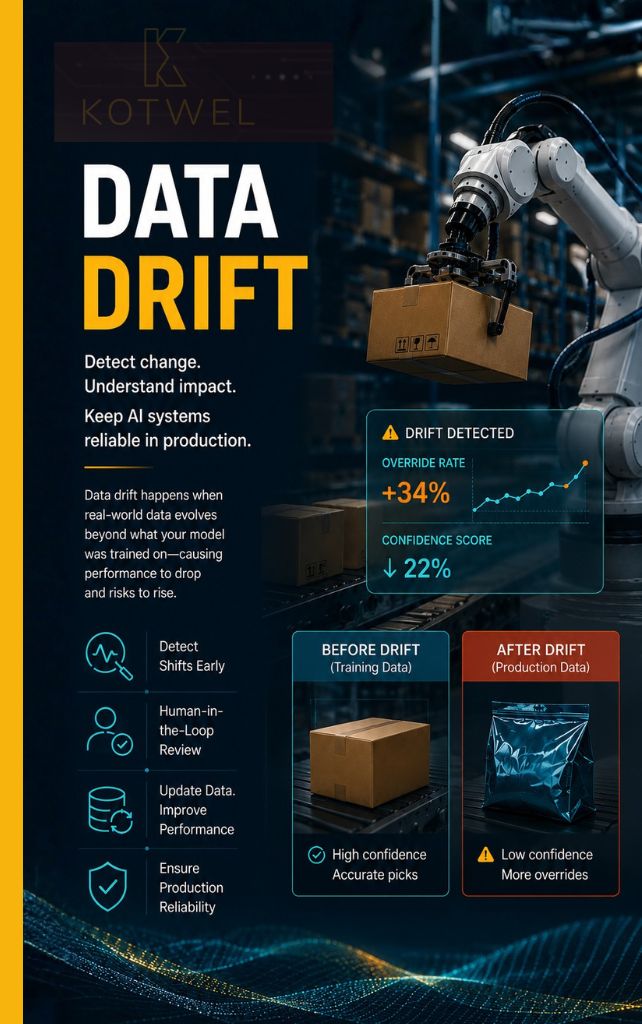
Production AI systems change because the world around them changes. Kotwel helps teams detect field-data shifts, review edge cases, refresh validation sets, and turn production signals into governed dataset improvements.
The PRISM Reliability Model
PRISM is Kotwel's core operating framework for AI data reliability. Data drift enters the framework at the (R) Root Classification stage. Before a team can correct drift, they need to know whether the root cause is a changed environment, a sensor shift, a strained taxonomy, a stale validation set, or a breakdown in annotation consistency. Classification determines the response.
Kotwel organizes data reliability operations around the PRISM Reliability Model — a five-stage operating framework covering production signal intake, root classification, investigation review, structured dataset action, and monitoring governance. Each stage feeds the next; a gap in any one creates compounding risk across the production data system.
Why Data Drift Creates Reliability Risk
Many teams can detect that production data has changed. Fewer teams have a dependable operating workflow for deciding what the change means, which cases require review, whether labels need correction, and how validation coverage should be updated.
Field Data Gaps
Production systems encounter new conditions that were underrepresented in the original dataset, including geography, motion, device, lighting, weather, surface, or behavior changes.
Without a structured sampling process, field-data gaps go unreviewed until they become recurring failure patterns. Kotwel builds review queues from production samples — new geographies, sensor setups, surface types, and behavioral changes — so gaps become governed dataset actions before they affect system reliability.
Annotation Inconsistency
As new cases appear, reviewers may apply labels differently unless guidelines, examples, QA sampling, and escalation rules are recalibrated.
Reviewer drift is a data reliability risk, not a reviewer quality problem. When production data outpaces annotation guidelines, disagreement rates rise and label consistency breaks down across batches. Kotwel recalibrates reviewers with updated examples, revised edge-case rules, and adjusted QA sampling rates — restoring consistency before annotation drift compounds into model drift.
Stale Evaluation Data
A validation set that once reflected reality can become less useful after the product, users, environment, or sensor setup changes.
A stale validation set doesn't just produce misleading metrics — it hides active reliability risk. When evaluation data no longer reflects current production conditions, teams may report acceptable performance while the system fails on the exact scenarios it now encounters most. Kotwel refreshes validation coverage around field-data gaps, recurring failure modes, and the edge cases that matter most to current deployment.
Find out how data drift review can improve your production AI system
Related AI Reliability Domains
AI data reliability depends on connected operational systems across validation workflows, human review, robotics data operations, multimodal synchronization, and production feedback pipelines. These related domains support the governance, QA, and lifecycle management required for dependable production AI systems.
AI Data Reliability
Production-focused data operations for dataset quality, annotation QA, validation workflows, drift review, and feedback-driven improvement.
Dataset Quality
Reliable AI systems depend on datasets that are complete, consistent, representative, and maintained through structured quality and validation standards.
Production AI Challenge
How production AI issues often originate from dataset gaps, validation drift, feedback disconnection, and operational inconsistency.
Robotics AI Data
Robotics systems introduce temporal consistency, sensor fusion, spatial reasoning, and field-feedback challenges that require specialized reliability operations.
Human-in-the-Loop Validation
Human review supports ambiguity resolution, escalation handling, reviewer calibration, and validation governance for production AI systems.
Multimodal AI Systems
Multimodal AI requires synchronized data workflows across text, image, video, audio, and sensor inputs throughout production environments.
Frequently Asked Questions (FAQs)
Top Questions We Get Asked Most Often About Data Drift in Production AI

Have more questions? Please get in touch with us, we will gladly answer your questions.