

AI Data Reliability for Production AI and Robotics Systems
Kotwel supports AI and robotics teams by connecting raw telemetry, annotation workflows, QA validation, and production model behavior into a reliable operational pipeline.
We provide the human-in-the-loop data reliability layer required to validate edge cases, stabilize multimodal inputs, calibrate reviewers, and convert field failures into governed dataset improvements.
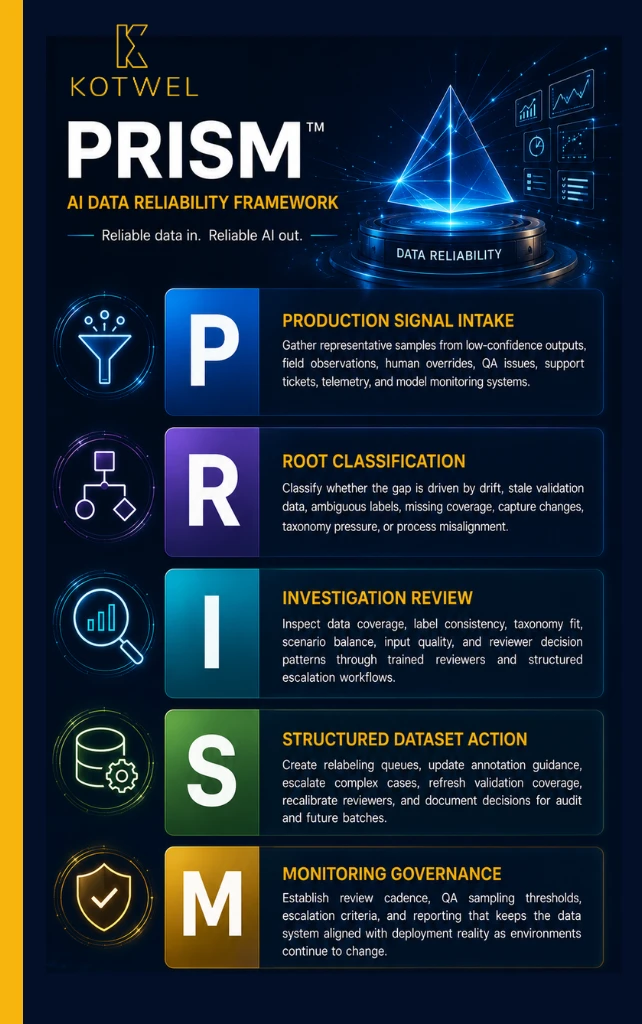
The PRISM Reliability Model
PRISM is Kotwel's core operating framework for AI data reliability.
Kotwel organizes data reliability operations around the PRISM Reliability Model — a five-stage operating framework covering production signal intake, root classification, investigation review, structured dataset action, and monitoring governance. Each stage feeds the next; a gap in any one creates compounding risk across the production data system.
Production AI Systems Need a Data Reliability Layer
Once a model is deployed, reliability depends on more than model architecture. Annotation guidelines can drift, validation sets can become stale, reviewer interpretation can split across teams, and production signals may never reach the dataset owners. A data reliability layer keeps annotation, validation, drift review, and feedback operations connected to the environment where the model actually runs.
Labeling Consistency
Guidelines, reviewer calibration, sampling, consensus review, and correction workflows keep labels aligned across teams, batches, tools, and time.
Without calibration systems, annotation standards gradually diverge across reviewers and projects. Small interpretation differences accumulate into inconsistent labels, unstable validation results, and unreliable retraining data.
Data Drift Review
After launch, production environments rarely remain stable. Kotwel helps identify new scenarios, ambiguous cases, sensor variation, field-data gaps, and dataset shifts that weaken model performance.
Production AI systems often fail because new environmental conditions never reach the training pipeline. Drift review operations help convert field observations, telemetry anomalies, and edge-case failures into governed dataset updates.
Human Validation
Human-in-the-loop review identifies ambiguous predictions, taxonomy conflicts, low-confidence outputs, and recurring failure patterns before they propagate into production workflows or retraining cycles.
Automated QA systems can detect structural errors, but they struggle with ambiguity, multimodal inconsistency, and edge-case interpretation. Human review remains critical for escalation handling, validation governance, and production reliability oversight.
Find out how reliable data operations can improve your production AI system
Related AI Reliability Domains
AI data reliability depends on connected operational systems across validation workflows, human review, robotics data operations, multimodal synchronization, and production feedback pipelines. These related domains support the governance, QA, and lifecycle management required for dependable production AI systems.
Data Drift
Production environments change after deployment. Data drift explains how new user behavior, sensor variation, content shifts, and field conditions affect model reliability.
Dataset Quality
Reliable AI systems depend on datasets that are complete, consistent, representative, and maintained through structured quality and validation standards.
Production AI Challenge
How production AI issues often originate from dataset gaps, validation drift, feedback disconnection, and operational inconsistency.
Robotics AI Data
Robotics systems introduce temporal consistency, sensor fusion, spatial reasoning, and field-feedback challenges that require specialized reliability operations.
Human-in-the-Loop Validation
Human review supports ambiguity resolution, escalation handling, reviewer calibration, and validation governance for production AI systems.
Multimodal AI Systems
Multimodal AI requires synchronized data workflows across text, image, video, audio, and sensor inputs throughout production environments.
Frequently Asked Questions (FAQs)
Top Questions We Get Asked Most Often About AI Data Reliability

Have more questions? Please get in touch with us, we will gladly answer your questions.